Artificial Turf vs. Natural Turf in San Diego: Cost, Heat, Maintenance, and Longevity
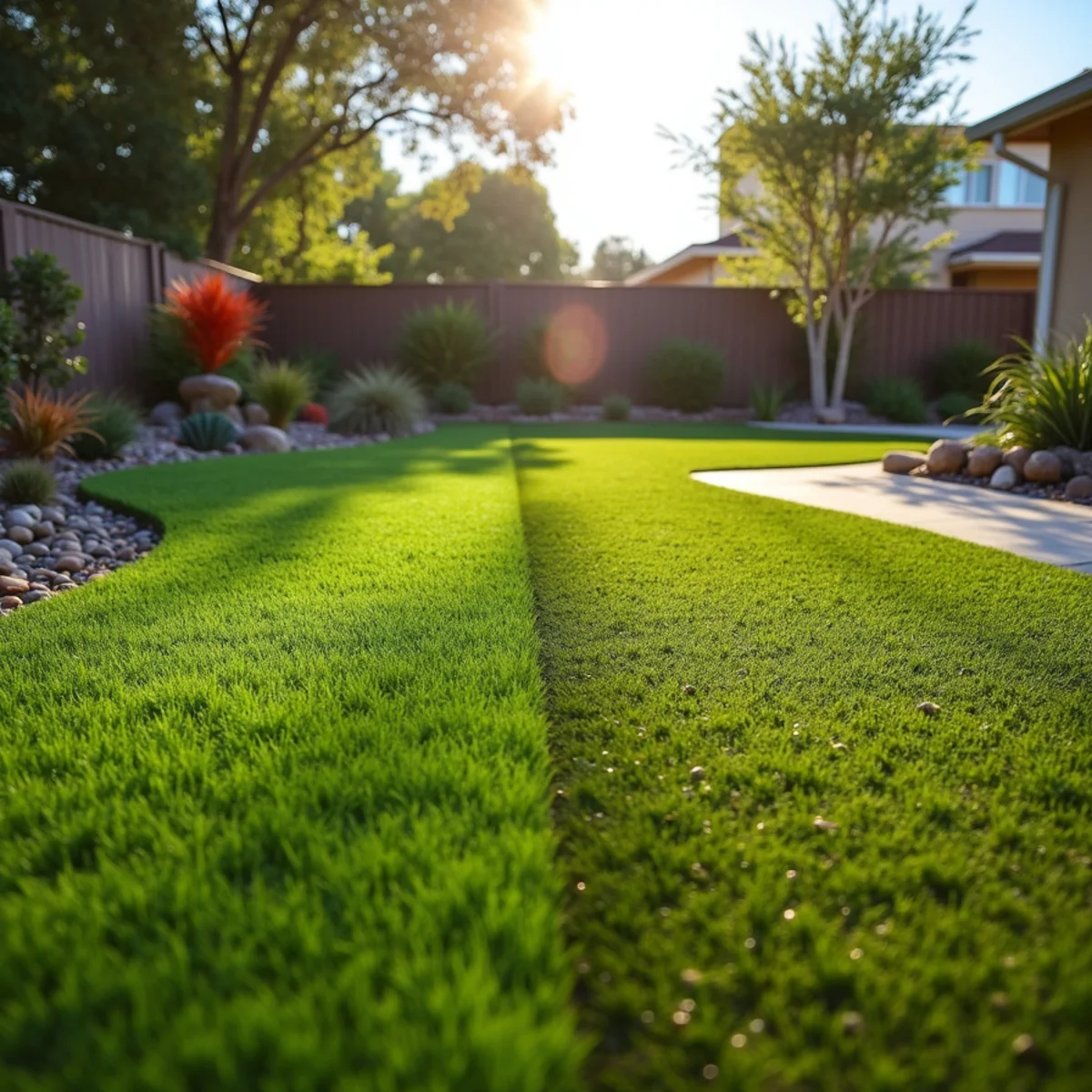
Both have a place in San Diego yards. Here is a straight comparison on cost, heat, maintenance, water, and lifespan so you can choose without the sales pitch.
Artificial turf has gone from a hard sell to a default option in San Diego, but it is not automatically the right choice for every yard. Here is an honest side-by-side so you can decide based on how you actually use the space — not a pitch.
Upfront cost
Natural sod is far cheaper to install per square foot. Artificial turf costs more upfront because most of the investment is the base — excavation, compacted aggregate, and drainage — plus the turf itself. The gap narrows over time as natural grass keeps costing water and maintenance while turf does not.
Water and maintenance
This is where turf wins decisively in our climate. Natural grass needs regular water, mowing, feeding, and reseeding — see our lawn care and turf maintenance service for what that upkeep involves. Artificial turf needs essentially none: an occasional rinse and brush. Under watering restrictions, that difference is the whole argument for many homeowners.
Heat
Natural grass stays cooler in direct sun. Artificial turf runs warmer, though quality infill, lighter tones, and shade keep it usable. In the hottest inland and desert areas like Indio and El Cajon, we account for this in product selection; near the coast it is rarely an issue.
Longevity and the base
Quality artificial turf on a properly built base lasts 15–20 years. Natural grass lasts indefinitely if maintained, but “maintained” is doing a lot of work in that sentence. For turf, the base is everything — a cheap install ripples and drains poorly within a year, the same lesson as why paver driveways sink.
Quick guide
- Choose artificial turf for: pets, low maintenance, water savings, shaded or moderate-sun yards, putting greens.
- Choose natural grass for: large open areas, the feel of real grass, tight budgets upfront, heavy-sun cool comfort.
- Choose drought-tolerant planting for: yards you do not need as a walkable lawn at all — often the best value of all.
Not sure a lawn is even the right call? Many yards are better served by drought-tolerant landscaping — see converting lawns to xeriscape. We install turf and maintain natural lawns across El Cajon and Santee; call (323) 606-0255 for a straight recommendation.
The 10-year cost picture, not just day one
Compared on installation day, natural sod wins on price — it is far cheaper per square foot than artificial turf, where most of the cost is the base. But the day-one number is the wrong comparison. Over ten years, natural grass keeps spending on water, mowing, feeding, and reseeding, while quality turf on a proper base just sits there, green. Run the math across a decade and the gap narrows sharply or flips, especially as water rates climb.
That said, turf is not automatically right. Large open areas, tight upfront budgets, and homeowners who love the feel of real grass still favor sod — maintained through our lawn care and turf maintenance service. And for yards that are not really used as a lawn at all, drought-tolerant planting often beats both on cost and character.
Whatever you choose, the base decides turf’s lifespan — the same lesson as why paver driveways sink. A cheap install ripples and drains poorly within a year.
Quick decision guide
- Pets, low maintenance, water savings, shaded or moderate sun → artificial turf.
- Large open lawns, tight upfront budget, the feel of real grass → natural sod.
- A yard you don’t use as a walkable lawn → drought-tolerant planting.
- Putting practice or a play surface → synthetic turf or a putting green.
- Hottest inland/desert yards → lighter-toned turf, more shade, or planting.
How to tell a quality turf install from a cheap one
Two artificial-turf lawns can look identical the day they are finished and be completely different a year later. The tells are almost all in the work you cannot see once the turf is down. A quality install starts with a deep, compacted, permeable base graded to drain; a cheap one lays turf over thin or uncompacted fill, and within a season it ripples, holds water, and — in pet areas — holds odor. Seams are the other giveaway: done right they disappear, done fast they show as a visible line down the yard.
Ask specifically about base depth, drainage, infill type, and seaming, and how pet areas are handled. A contractor who builds artificial turf properly answers without hesitation — the same base-first discipline behind paver work.
- A deep, compacted, permeable base graded to drain.
- Invisible seams, not a visible line across the lawn.
- Proper infill that stands the blades up and resists odor.
- Pet-specific drainage and antimicrobial infill in pet areas.
- A flat, stable surface with no ripples or soft spots.
We install turf and maintain natural lawns across El Cajon and Santee.
Frequently Asked Questions
Is artificial turf cheaper than grass?
Does artificial turf get too hot in San Diego?
How long does artificial turf last?
Is artificial turf safe and comfortable for kids and pets?
How do I keep artificial turf from getting too hot?
Need help with this in Southern California?
SOCAL EXTERIOR SERVICES, INC is a licensed San Diego landscaping and hardscaping contractor. Get a free, honest estimate from a local team that does the work right.